Programme Atlas
The canonical public map of how a mathematical question changes state as it moves through discovery, solving, certification, and programme integration.
What the Atlas represents
The Atlas describes programme transitions. It does not certify any theorem.
A mathematical object can move through several support states without reaching certification. The programme preserves each transition so that a later reader can recover what changed and why.
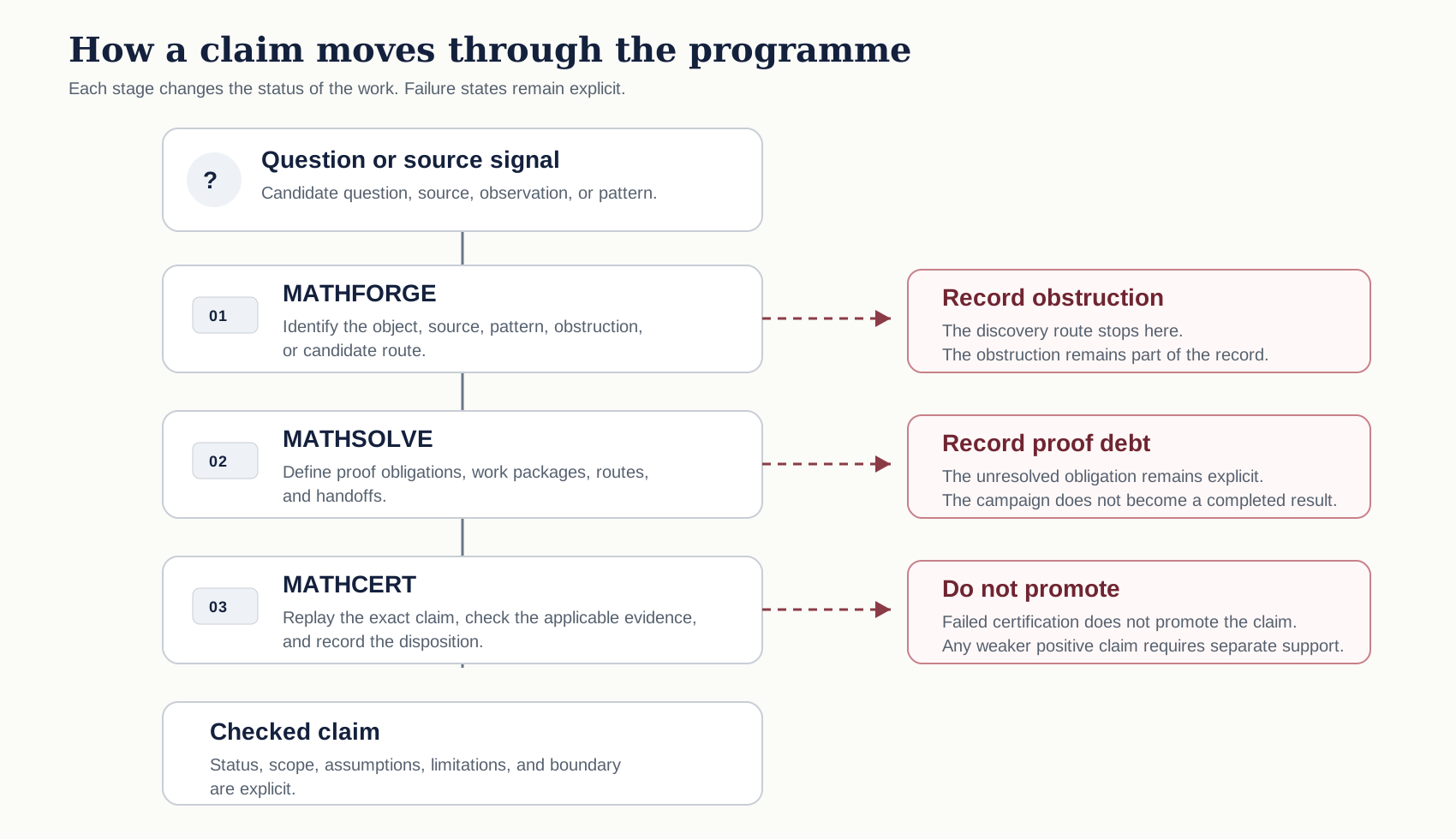
The diagram is schematic. The arrows represent allowed research-state transitions, not logical implication between mathematical statements.
Three mathematical execution pillars
| Pillar | Governing question | Typical artifacts | Boundary preserved |
|---|---|---|---|
| MATHFORGE | What object, source, obstruction, or candidate route is actually available? | source records, problem cards, reconnaissance, finite screens, route suggestions | discovery evidence does not become a mathematical result by presentation alone |
| MATHSOLVE | Which exact obligations must close before the target can advance? | theorem spines, work packages, proof-debt registers, local lemmas, handoffs | active work does not become a completed result |
| MATHCERT | Which exact claim survives the declared checks? | formal statements, exact replays, certificate checks, adjudications, claim dispositions | evidence and exposition do not become certified truth without the required gate |
MATH-PROGRAMME is the integration layer. It preserves programme state, routing, terminology, decisions, publication surfaces, and archives. It is not a fourth mathematical support route.
State changes
| Research state | Main question | Minimum reader-visible result |
|---|---|---|
| Question or source signal | What is worth reconstructing? | object and source identity |
| Reconstructed object | What was actually stated or observed? | normalized statement, provenance, and imported assumptions |
| Solving campaign | What finite obligation can be attacked? | theorem-spine location, dependencies, and completion test |
| Local evidence | What proof, computation, certificate, or obstruction exists? | classified support route and limitations |
| Certification handoff | What exact claim is ready to be checked? | immutable statement, dependencies, evidence, and replay contract |
| Checked claim | What survived the declared gate? | bounded disposition and retained exclusions |
| Integrated record | What is the authoritative current account? | protected record with review, provenance, and continuation state |
Not every object reaches the last row. A failed route can be a complete programme result when it records the exact obstruction and narrows the remaining search space.
Fail-closed exits
MATHFORGE exit · recorded obstruction
A source may be incomplete, inconsistent, unavailable, or insufficient for the intended claim. MATHFORGE records that obstruction instead of inventing the missing bridge.
MATHSOLVE exit · proof debt
A campaign may isolate a theorem-level dependency that is not yet proved. MATHSOLVE records the dependency, its role, and the conditions that would discharge it.
MATHCERT exit · non-promotion
A certificate, formalization, or replay may fail, or it may support only a narrower claim than the proposed output. MATHCERT preserves the narrower boundary and refuses the unsupported promotion.
Support-route classes
The public explanation should identify which class supports a consequential statement.
| Support class | What it can establish |
|---|---|
| Exploratory evidence | patterns and candidate hypotheses |
| Regression audit | continued agreement among definitions, examples, and code paths |
| Exact finite verification | the explicitly bounded finite claim |
| Certificate replay | the local claim represented by the replayable certificate |
| Formal proof | the formal statement accepted by the declared trusted environment |
| Continuum proof | the full mathematical statement over the stated domain |
| Negative result | a bounded obstruction that rules out a declared route or claim |
The classes are not interchangeable. Exact finite verification is not continuum proof. A visualization is not mathematical evidence by itself. A formal proof of the wrong statement does not establish the intended human claim.
Semantic bridge
Every formal or computational route must preserve the bridge between the human claim and the checked object.
A reader should be able to recover:
- the human statement;
- the formal or computational statement;
- assumptions added or removed in translation;
- model-class or foundational restrictions;
- the evidence that supports the bridge;
- what would falsify or downgrade the bridge.
If the bridge remains unaudited, the formal or computational artifact can still be useful. The broader human claim remains below certification.
How to route a new item
Use the smallest pillar that matches the present state.
- Send an unclear source, object, or candidate route to MATHFORGE.
- Send a normalized target with unresolved mathematics to MATHSOLVE.
- Send an exact claim with a declared replay or proof surface to MATHCERT.
- Use MATH-PROGRAMME to preserve cross-pillar routing, public state, governance, and archival continuity.
Do not route by prestige. Route by the support state of the object.
Reader continuation
For live work, use Current Work. For bounded checked outputs, use Results and Exemplars. For standing domains, use the Mathematical Estate. For review posture, use the Grand Challenge Reader Guide.