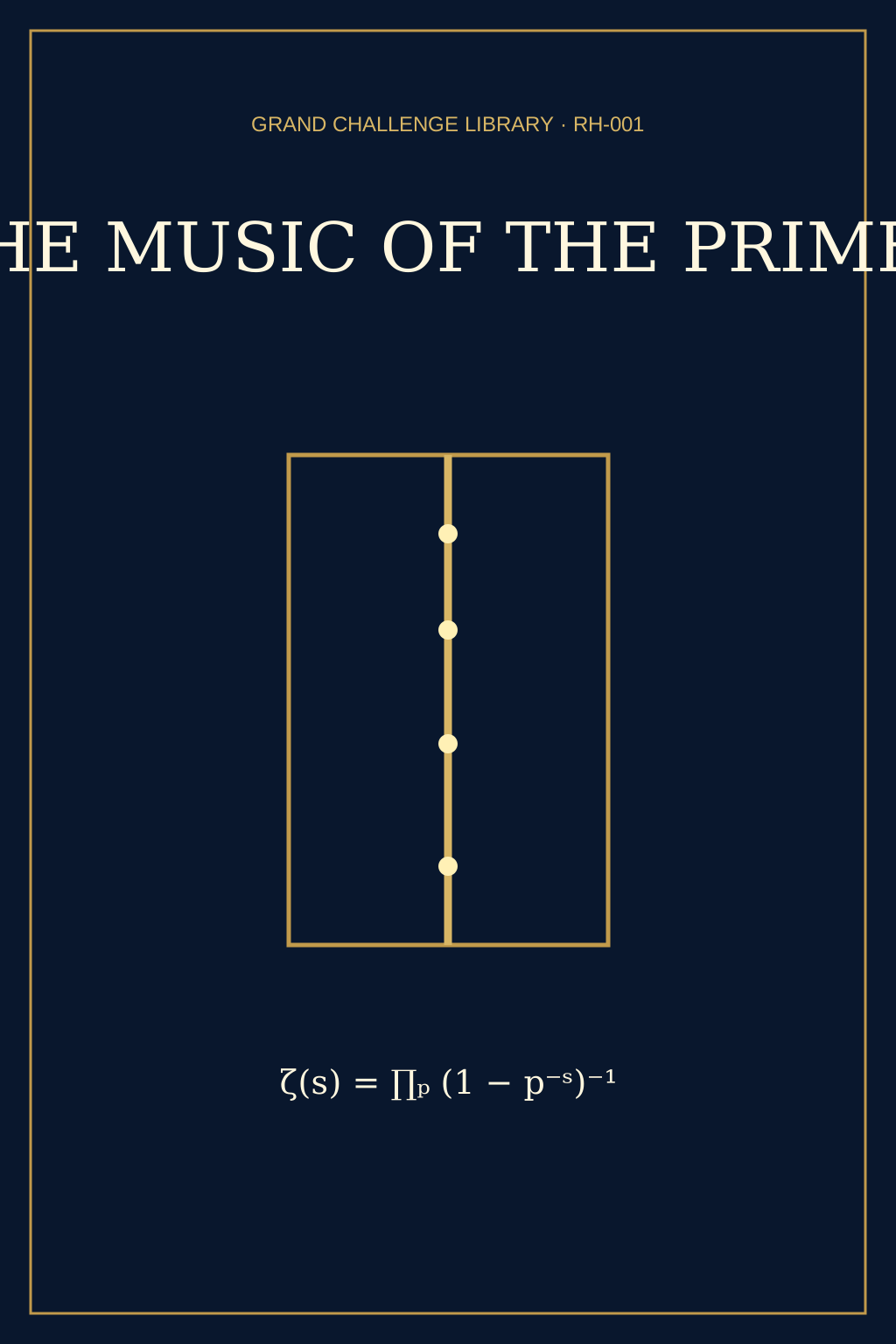
MATH-PROGRAMME · Documentary Treatment · RH-001
The Music of the Primes
A guided journey from the Euler product to the critical line
The zeros of one complex function conduct the fluctuations of the primes; the hypothesis places every nontrivial zero on a single vertical line.
A note to the reader
## How to Read the Music Prime numbers appear irregular, yet their collective distribution is encoded by the zeros of the Riemann zeta function. The hypothesis is an infinite universal statement beyond any finite computation. Musical waves and celestial lines are memory devices; analytic continuation, zero taxonomy, multiplicity, interval certification, and the exact quantifier govern the mathematics. **Edition status:** Open Millennium Prize Problem; analytic-number-theory documentary; no zero-free proof claim.Every nontrivial zero \(\rho\) of \(\zeta(s)\) satisfies \(\operatorname{Re}\rho=\tfrac12\).
Symmetry, a vast finite verification, a positive proportion on the line, random-matrix agreement, or a proposed spectral analogy does not prove the universal statement.
Chapter I
## Primes Become an Analytic Function For \(\operatorname{Re}(s)>1\), \[\zeta(s)=\sum_{n=1}^\infty n^{-s}=\prod_p(1-p^{-s})^{-1}.\]The Euler product is the analytic expression of unique prime factorization in its half-plane of absolute convergence.
The product implies \(\zeta(s)\ne0\) for \(\operatorname{Re}(s)>1\). The prime number theorem is equivalent to zero-freeness on \(\operatorname{Re}(s)=1\).
Chapter II
## Beyond the Half-Plane The zeta function extends meromorphically to the plane with a simple pole at one. The completed function \[\xi(s)=\tfrac12s(s-1)\pi^{-s/2}\Gamma(s/2)\zeta(s)\] is entire and satisfies \(\xi(s)=\xi(1-s)\).Analytic continuation and the functional equation produce symmetries under \(s\mapsto1-s\) and complex conjugation. Symmetry alone does not force each zero onto the symmetry axis.
Chapter III
## The Critical Strip Trivial zeros occur at the negative even integers. Nontrivial zeros lie in \(0<\operatorname{Re}(s)<1\). The critical line is \(\operatorname{Re}(s)=1/2\).A nontrivial zero is a zero of the analytically continued zeta function that is not a negative even integer. RH concerns every such zero, counted with multiplicity.
Infinitely many zeros and a positive proportion are known to lie on the critical line; zero-free regions and density estimates constrain the remainder. “Many” is not “all.”
Chapter IV
## How Zeros Conduct the Primes Schematically, \[\psi(x)=x-\sum_\rho\frac{x^\rho}{\rho}-\log(2\pi)-\tfrac12\log(1-x^{-2}),\] with an exact summation convention. A zero \(\rho=\beta+i\gamma\) contributes an oscillation of approximate size \(x^\beta\).The zero sum is not an ordinary absolutely convergent series. Truncation, multiplicity, poles, trivial zeros, and error terms must all be controlled.
Chapter V
## The Infinite Quantifier Rigorous computation can certify every zero up to a height, provided a completeness method proves none were missed. Equivalent criteria translate RH into prime errors, divisor inequalities, Li coefficients, approximation, or positivity statements. An equivalence is a new doorway, not a proof. Random-matrix statistics model observed spacings; Hilbert–Pólya proposes a self-adjoint spectral explanation. No accepted operator satisfying the required identities has been constructed.Every verified interval is bounded. RH asks about all nontrivial zeros without an upper height.
The primes provide the rhythm. The zeros conduct the deviations. The critical line is the unresolved score.
Technical appendix A
## The Completed Xi-Function The Hadamard product encodes nontrivial zeros with the appropriate canonical-product interpretation. Reality and functional symmetry produce quartets \(\rho,\bar\rho,1-\rho,1-\bar\rho\), with degeneracies on symmetry lines.Technical appendix B
## Zero Counting and Prime Error \[N(T)=\frac{T}{2\pi}\log\frac{T}{2\pi}-\frac{T}{2\pi}+O(\log T).\] Turing-style methods compare a computed list with an independent zero count. RH implies strong prime-error estimates with logarithmic qualifications; suitable error estimates conversely constrain zero location.Technical appendix C
## Rigorous Computation and Equivalent Criteria The Riemann–Siegel formula accelerates critical-line evaluation. Gram patterns have exceptions. Rigorous verification requires interval control, root isolation or argument variation, and an independent completeness count. Robin, Lagarias, Li, Nyman–Beurling, and Weil-type criteria retain their exact hypotheses.Technical appendix D
## Spectral Analogies and Trust Matrix | Claim | Trust class | Qualification | |---|---|---| | Euler product for \(\operatorname{Re}(s)>1\) | established | absolute convergence | | Continuation and functional equation | imported established | global zeta structure | | Nontrivial zeros lie in the critical strip | established | outer half-planes excluded | | Positive proportion on critical line | imported established | not all zeros | | Finite-height verification | bounded theorem | needs completeness certificate | | Random-matrix agreement | empirical/heuristic | no location proof | | Hilbert–Pólya | research programme | operator not constructed | | Riemann Hypothesis | open | every nontrivial zero | | Generalized RH | separate family | not identical to RH | | Illuminated plates | pedagogical | never authoritative zero plots |This edition does not prove RH, GRH, a new zero-free region, a new critical-line proportion, or a self-adjoint Hilbert–Pólya operator.
Sources and programme crosswalk
## Governing literature and campaign record Programme links: [Domain 08](../../domains/riemann_hypothesis/) · [claim-authority record](https://github.com/grandchallenge/MATH-PROGRAMME/blob/main/RH-WP00-source-normalization-equivalence-audit.md) · [campaign artifacts](https://github.com/grandchallenge/MATH-PROGRAMME/tree/main/campaigns/riemann_hypothesis) · [review records](https://github.com/grandchallenge/MATH-PROGRAMME/tree/main/reviews/riemann_hypothesis)Edition record
This browser-native edition uses the immutable Poincaré reference contract and shared open-problem status vocabulary. Native SVG plates are pedagogical; semantic HTML preserves the finite-versus-infinite boundary.
The committed pointer is a source record; the checksum-locked complete illustrated source bundle is the authoritative source artifact. MathJax 3.2.2 is a version-pinned network enhancement, and the source TeX remains present when unavailable.
Web claim boundary: Browser-native, source-normalized exposition of the Riemann Hypothesis. Functional-equation symmetry, finite zero verification, zero-density and critical-line proportion theorems, equivalent criteria, random-matrix agreement, prime-error heuristics, the de Bruijn–Newman constant, and Hilbert–Pólya analogies are not promoted to the universal assertion that every nontrivial zero has real part one half.
- Rendered PDF
- 13,938,685 bytes ·
aa573c7fe1201f9edf43c01dcf1f22d427bbbbe7728165281dffdda3a4c2626c·metadata_only - Complete LaTeX source
- 55,302 bytes ·
e0d778b53d0ea924b7ac5e3a7304fa5eeb0e61bea4bccc470bfd7550028235a0·metadata_only - Authoritative complete illustrated source bundle
- 14,027,469 bytes ·
b97653729ff130efbe6badc56e258b55b3a0ca2d279075753c46184f8349c4c0·metadata_only