MATH-PROGRAMME · Documentary Treatment · YM-001
The Geometry of Force and Silence
A guided journey through gauge fields, quantum existence, and the mass gap
A rigorous quantum gauge theory must first exist; only then can its vacuum spectrum be shown to begin with a strictly positive gap.
A note to the reader
## How to Read the Field Yang–Mills theory begins with local symmetry and becomes the geometric language of fundamental interactions. The Millennium problem is not merely to manipulate the classical equation or estimate a lattice spectrum. It asks for a nontrivial quantum field theory in four dimensions, constructed with rigorous axioms, and for a strictly positive spectral gap above its vacuum. **Edition status:** Open Millennium Prize Problem; constructive quantum-field obligation; no mass-gap proof claim.For every compact simple gauge group \(G\), construct a nontrivial quantum Yang–Mills theory on \(\mathbb R^4\) satisfying axioms at least as strong as Wightman or Osterwalder–Schrader requirements, and prove a positive mass gap.
Classical solutions, lattice simulations, perturbative renormalization, confinement heuristics, and a finite-volume glueball spectrum are not the required continuum construction.
Chapter I
## Symmetry That Changes from Point to Point A gauge field is geometrically a connection \(A\) on a principal \(G\)-bundle. Under a local transformation \(g\), \[A\longmapsto gAg^{-1}-(dg)g^{-1}.\]Gauge symmetry is redundancy in the choice of local internal frame. A physical observable must be gauge invariant or belong to a rigorously controlled gauge-fixed construction.
Chapter II
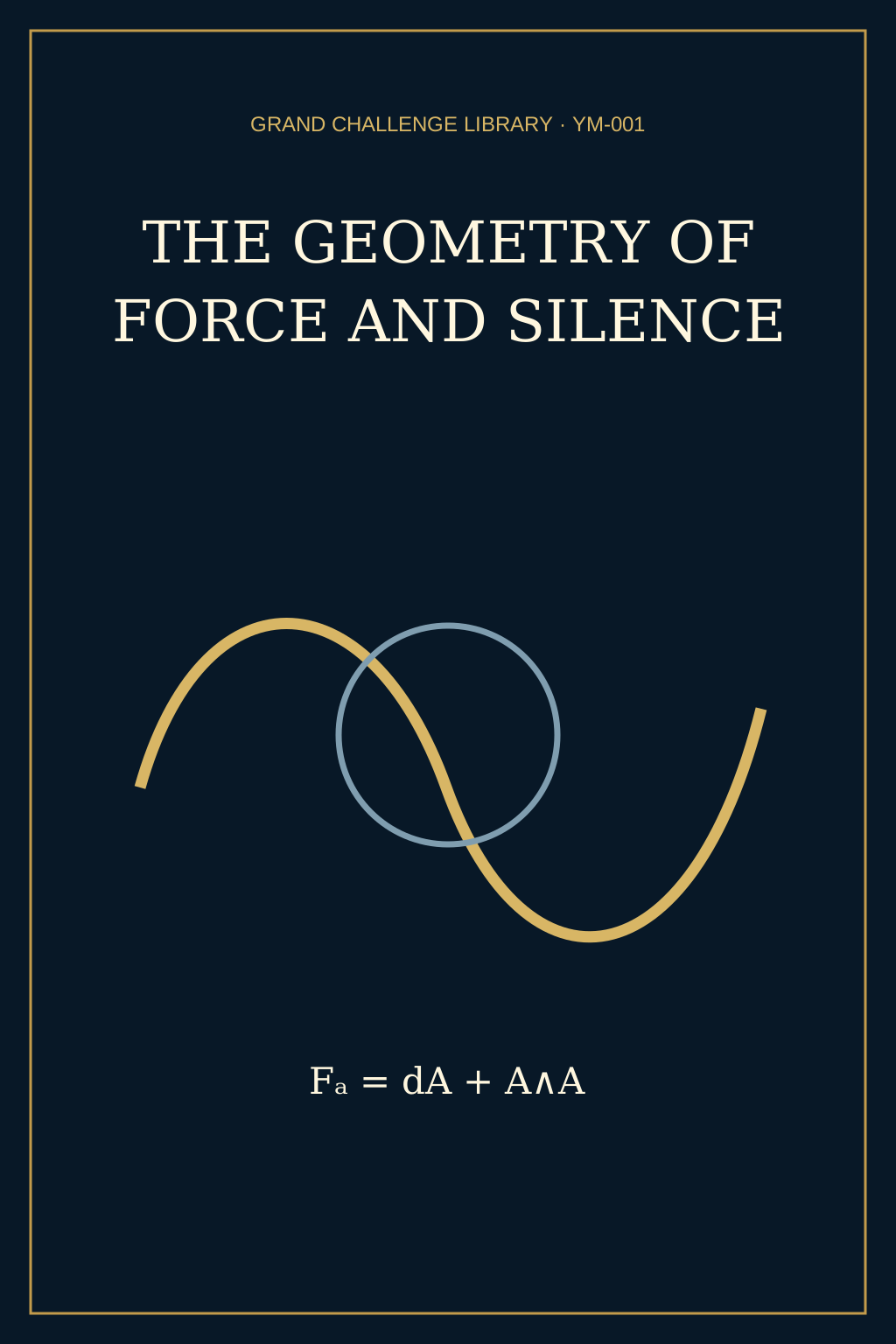
## Connection, Curvature, and Holonomy \[F_A=dA+A\wedge A.\] Curvature measures infinitesimal holonomy. The nonabelian quadratic term means the field interacts with itself. Wilson loops are traces of holonomy around closed curves and provide gauge-invariant observables.An instanton is a finite-action Euclidean solution with self-dual or anti-self-dual curvature. It reveals topology and nonperturbative sectors but does not construct the full quantum measure.
Chapter III
## The Classical Equation \[S(A)=\frac1{2g^2}\int\langle F_A,F_A\rangle\,d^4x,\qquad D_A^*F_A=0.\]Connections, curvature, instantons, compactness modulo gauge under controlled energy, and substantial classical evolution theory are rigorous mathematical subjects.
A theorem about smooth classical fields does not construct quantum correlation functions, a positive Hilbert space, local observables, or the quantum spectrum.
Chapter IV
## The Quantum Construction Obligation The formal integral \(Z=\int e^{-S(A)}\,\mathcal DA\) is not a construction. One needs regulated measures or correlators, renormalization, gauge-invariant observables, positivity, locality, regulator removal, infinite volume, and nontriviality.Osterwalder–Schrader data require Euclidean invariance, symmetry, reflection positivity, regularity, and clustering sufficient for reconstruction. Wightman formulations require a Hilbert space, vacuum, locality, covariance, and spectral positivity.
Chapter V
## The Silence Above the Vacuum For Hamiltonian \(H\) and vacuum \(\Omega\), a gap \(\Delta>0\) means \[\operatorname{spec}(H)\cap(0,\Delta)=\varnothing.\] Under suitable hypotheses this yields exponential clustering of connected gauge-invariant correlations.Mass gap
A positive spectral interval above the vacuum.
Quantitative exponential clustering.
Confinement
No isolated colour-charged asymptotic states.
Often probed through Wilson loops.
The theory must first be constructed nontrivially in the continuum; the positive physical gap must then be proved in its Hamiltonian spectrum.
The problem asks for both the instrument and the silence between its lowest notes.
Technical appendix A
## Bundles, Connections, and Action The Bianchi identity is \(D_AF_A=0\), and curvature transforms homogeneously. In four Euclidean dimensions the action is scale critical. Self-dual instantons saturate the topological action bound under fixed normalization.Technical appendix B
## Wightman and Osterwalder–Schrader Obligations Reflection positivity becomes positivity of the reconstructed Hilbert-space inner product. Gauge-fixed elementary fields may violate positivity, so the observable algebra and reconstruction domain must remain explicit. Existence requires a consistent family of distributions, not convergence of selected correlators.Technical appendix C
## Spectral Gap and Correlation Decay A finite-volume spectrum is discrete even without an infinite-volume mass gap. Uniformity in volume and cutoff is essential. The bridge from exponential Euclidean decay to a Hamiltonian gap requires spectral representation and exact observable hypotheses.Technical appendix D
## Lattice, Renormalization, and Trust Matrix | Claim | Trust class | Qualification | |---|---|---| | Classical gauge geometry | established | not quantum existence | | Finite-lattice gauge theory | established regulator | not the continuum theory | | Perturbative asymptotic freedom | imported established | perturbative control | | Strong-coupling lattice gap/area law | theorem in regime | requires continuum transfer | | Numerical glueball spectrum | empirical | finite cutoff and volume | | Axiomatic continuum existence | open | joint construction obligation | | Positive physical mass gap | open | spectrum after construction | | Confinement | related property | not definitionally the gap | | Illuminated plates | pedagogical | never authoritative field diagrams |This edition does not construct the quantum measure, remove regulators, prove nontriviality, establish a continuum area law, or prove a positive Hamiltonian gap.
Sources and programme crosswalk
## Governing literature and campaign record Programme links: [Domain 06](../../domains/yang_mills/) · [claim-authority record](https://github.com/grandchallenge/MATH-PROGRAMME/blob/main/YM-WP00-source-normalization-equivalence-audit.md) · [campaign artifacts](https://github.com/grandchallenge/MATH-PROGRAMME/tree/main/campaigns/yang_mills) · [review records](https://github.com/grandchallenge/MATH-PROGRAMME/tree/main/reviews/yang_mills)Edition record
This browser-native edition uses the immutable Poincaré reference contract and shared open-problem status vocabulary. Native SVG plates are pedagogical; semantic HTML preserves the construction and spectrum obligations.
The committed pointer is a source record; the checksum-locked complete illustrated source bundle is the authoritative source artifact. MathJax 3.2.2 is a version-pinned network enhancement, and the source TeX remains present when unavailable.
Web claim boundary: Browser-native, source-normalized exposition of four-dimensional quantum Yang–Mills existence and mass gap. Classical solutions, instantons, perturbation theory, asymptotic freedom, finite-lattice models, strong-coupling expansions, numerical glueball spectra, supersymmetric theories, and confinement heuristics are not substituted for an axiomatic nontrivial continuum theory with a positive spectral gap.
- Rendered PDF
- 13,812,666 bytes ·
c8e2a57844dc7e4d83c0fc586c694d1c2db7d51bfb0556126f7a257d6049c7fb·metadata_only - Complete LaTeX source
- 74,484 bytes ·
f45045a908cc3b2ae27d24f892cbcfc139e516ba1ab1bbc3e44f37bd3308dd74·metadata_only - Authoritative complete illustrated source bundle
- 27,844,145 bytes ·
ac7920263aed80a7237d4174260e1198d9a60da8bb2c6800147262036b628910·metadata_only