Current Work
Time-sensitive navigation for material work now in motion. This page does not create mathematical authority; the linked protected records remain authoritative.
Reading rule
Each highlighted front is described through the same six fields:
- Status — the present support and lifecycle boundary.
- Object — the mathematical or engineering object under study.
- Obstruction — the smallest known reason the next promotion is not yet justified.
- Supported state — what protected work has already established.
- Claim boundary — what the current work does not establish.
- Next bounded move — the next finite action with a completion test.
This structure follows the programme pedagogy standard: status before suspense, object before method, obstruction before optimism, and one executable next move.
The detailed profiles below are a curated public orientation surface, not a complete inventory of active development. Additional active fronts are listed compactly after the highlighted profiles.
BSD-001 · literal-p=2 inverse-limit replay
Live tracker: MATHSOLVE #245
Programme owner: MATHSOLVE #215
Status: active solving campaign; MATHCERT certification is not claimed.
Object
The current object is the inverse-limit passage in Burns–Sakamoto–Sano Theorem 5.25 on the selected literal-2 lane.
The preceding WP60R replay established the protected finite-level interfaces used for the literal-2 replacement of Theorem 5.2. The current work asks whether those finite-level interfaces are sufficient for the inverse-limit theorem.
Obstruction
The published source imposes full Hypothesis 4.7. The protected campaign retains failure of the relevant infinite auxiliary-field H3 / Hypothesis-4.7(iii)-type vanishing condition.
The programme must therefore identify the exact uses of Hypothesis 4.7 in:
- transition maps between finite coefficient levels;
- regulator compatibility;
- the inverse-limit Kolyvagin system;
- compatibility of the ideals
I_i; - passage to
Fitt^i_{Z_2}of the inverse-limit dual Selmer module; - rank-one freeness and the regulator isomorphism.
Supported state
WP60R is protected and complete at the finite-level replay boundary. Its replacement stack may be used where admitted. The failed infinite auxiliary-field condition remains failed.
Claim boundary
This work does not establish Corollary 6.15, R5-LIFT, R5-PRIM, D2d, BSD-R2-A1, the failed infinite H3 condition, novelty, priority, or certification.
Next bounded move
Complete WP60S by one of two admissible outcomes:
- prove a selected literal-
2replacement of Theorem 5.25 with every inverse-limit compatibility stated; or - identify the first unrepaired inverse-limit dependency and record it as a named boundary with a proof witness.
The completion test is theorem-level: the replay either closes at the declared boundary or produces the first exact unrepaired dependency.
OZ-001 · order-7 certificate compression
Live tracker: MATH-PROGRAMME #964
Status: active certificate-construction route; T3 is neither proved nor refuted.
Object
The current object is the boundary-forced order-7 E1 residual-cofactor system in the Brown–Zudilin route.
Its homogeneous kernel has dimension 576. Programme reconstruction identifies that kernel exactly with a discrete-curl image parameterized by a polynomial H(k,l) of bidegree at most (23,23).
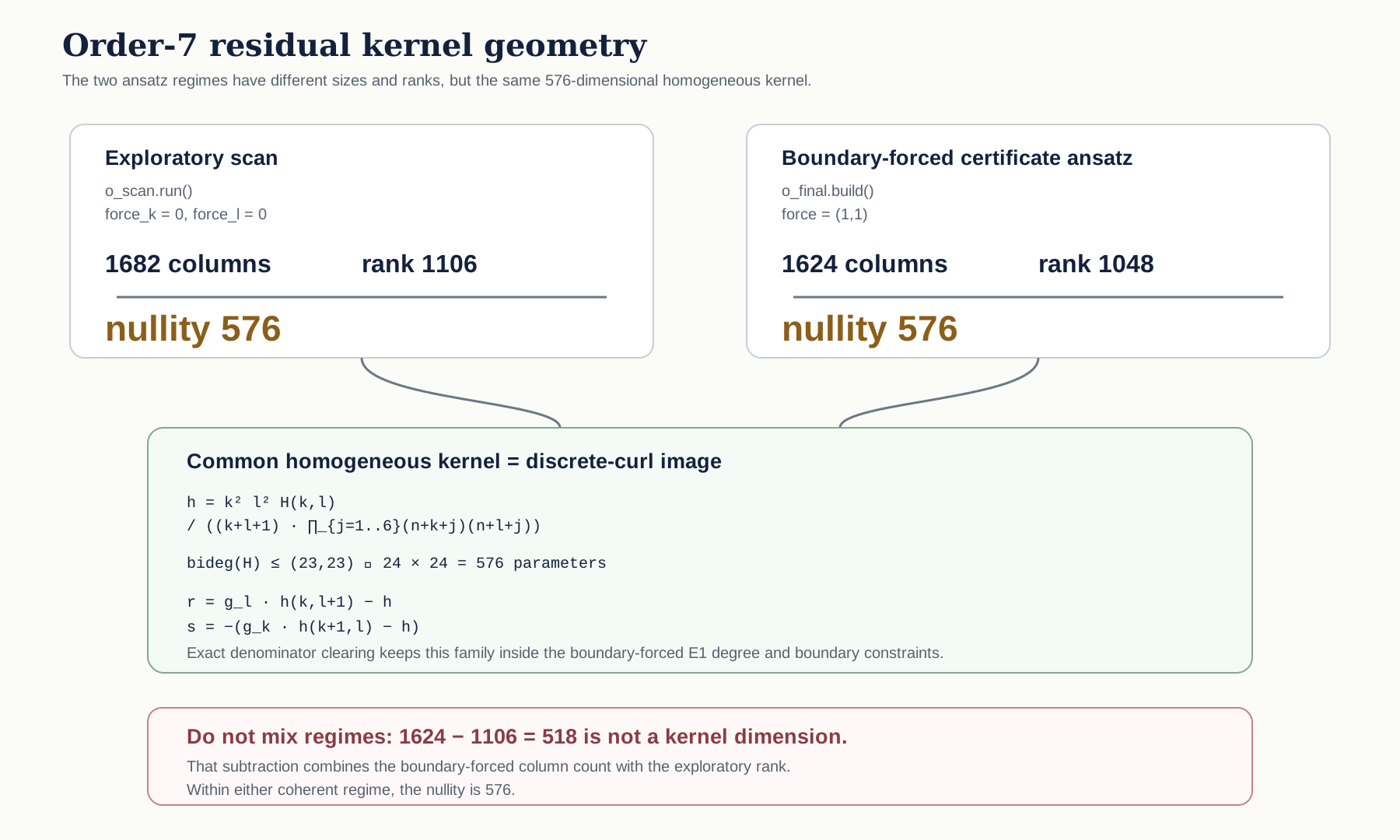
The visual is an exact structural summary of the two declared ansatz dimensions and the shared nullity. It is not itself a certificate.
Obstruction
The kernel dimension is no longer the active obstruction. The remaining problem is to construct a degree-reduced affine section over Q[n] and then replay it independently in characteristic zero.
The earlier value 518 is not a competing kernel dimension. It came from subtracting the exploratory rank 1106 from the boundary-forced column count 1624. Those quantities belong to different ansatz regimes.
Supported state
The current intermediate terminal is:
ORDER7_E1_KERNEL_IDENTIFIED_AS_DISCRETE_CURL__POTENTIAL_SECTION_REDUCTION_REQUIRED
Exact denominator clearing, boundary compatibility, and the characteristic-zero kernel inclusion support the 576-dimensional description. Modular nonzero-minor witnesses supply rank lower bounds. They do not replace characteristic-zero replay of a positive certificate.
Claim boundary
No global order-7 certificate has yet crossed the declared replay boundary. t3_proved = false, t3_refuted = false, and the work does not create irrationality, infinitude, novelty, publication, product, or commercial authority.
Next bounded move
Construct a shifted Popov, minimal-approximant, order-basis, or equivalent completeness-backed affine reduction for the seven standalone residual blocks.
A constructive completion must produce an explicit degree-reduced section. A positive route then requires independent exact replay over Q(n,k,l) before the certificate state can advance.
VGSE-001 · identifiability-aware infinitesimal inverse design
Live campaign tracker: MATH-PROGRAMME #1084
Live M2 tracker: MATH-PROGRAMME #1179
Status: M0 and M1 are terminal. M2 D0/D1 is the next separately governed tranche.
Object
M2 works with the four-dimensional labeled hinge-rate mechanism subspace from M1.
For an admissible TE3 realization g, let P_H(g) be the M1 orthogonal projector onto that subspace. The first inverse-design observable is the basis-invariant hinge-participation profile
d(g) = diag(P_H(g)) in [0,1]^10.
On the retained mobility-four class, the entries sum to 4.
Identifiability boundary
The required GCL-ID-00 preflight is governance/identifiability_preflights/VGSE-MS-M2-ID-001.json.
Its representative-level disposition is UNRESOLVED.
M1 already shows that one quotient point can have several geometric representatives with distinct mechanism subspaces. M2 additionally compresses the full projector to its diagonal. Therefore the current inverse target is deliberately set-valued:
construct one or more admissible design witnesses matching a target participation profile.
M2 does not claim recovery of a unique quotient or geometry.
Next bounded move
Execute D0/D1 only:
- generate the positive-control profile from the protected
BASELINE-B1branch using the exact M1 projector code; - replay profile invariants and side-information boundaries;
- build a deterministic witness-synthesis baseline;
- attempt a local branch-conditioned synthesis while preserving multiplicity;
- distinguish search/selector failure from structural non-identifiability.
D2 off-grid/interpolated targets are not pre-authorized by activation.
Claim boundary
M2 remains flat-state infinitesimal kinematic design under the GCL-defined model. It does not establish unique design recovery, finite rigid foldability, collision-free deployment, finite thickness, stiffness, force, energy, material/constitutive behaviour, actuation, manufacturing, product performance, source correspondence, novelty, patentability, or commercial value.
Additional active development
The programme's active development surface is broader than the three detailed profiles above. Two additional governed fronts currently in motion are:
| Front | Current state | Next bounded boundary |
|---|---|---|
| CMDG CM4 P3-M | Authorized research execution on finite-stage recovery from protected finite-coordinate dependence. | Prove or precisely block the finite-basis-set to common discrete-quotient bridge before attempting broader coefficient-morphism recovery. Tracker |
| NS-CI-001 | Active L5 direct critical-integral lane for the critical L^4_t L^6_x Navier–Stokes target; interface qualification only. |
Produce a genuinely equation-specific estimate that survives the existing false-proof controls. Tracker |
This compact list is also not a substitute for protected campaign registries and live trackers. It exists to prevent the public orientation surface from implying that active development has cardinality three.
When a front leaves this page
A front should be removed or rewritten when its live obligation is closed, superseded, or transferred to another programme surface. Historical records remain available through the estate, results, issues, and protected repository state.
This page should not preserve a closed issue as though it were still current. That rule is deliberate: current work and standing history are different axes.